The Break That Never Ended
Palmer Luckey left Cal State Long Beach for a headset and a Kickstarter. Years later he is careful about who should follow.
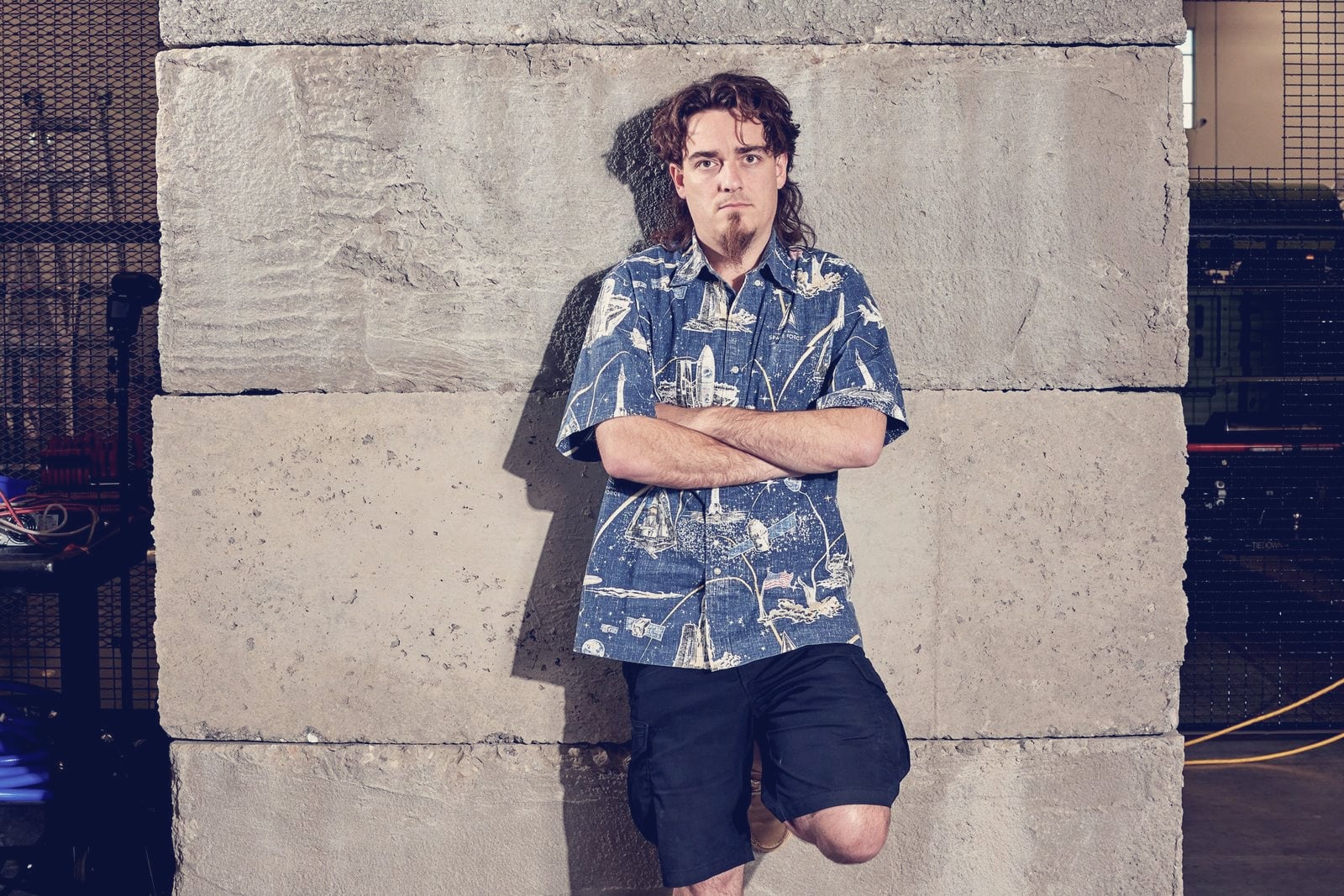
In 2012 Palmer Luckey was a journalism student at Cal State Long Beach, just past halfway to his degree, and a fixation on virtual reality that, TechCrunch says, began around the age of 15. Then the headset got a campaign page. Within weeks, by TechCrunch’s account, he had left school to start a company.
He does not describe it that way. “What I did when I started Oculus was really take a break from college. I didn’t think that I was dropping out,” he told CNBC Make It in 2018. The distinction is not pedantry. A dropout has made a judgment about school. Luckey says he made a judgment about timing, and left the door ajar.
The arc
The Kickstarter launched on August 1, 2012 with a modest goal of $250,000. Within 24 hours it had raised $670,000 from 2,750 people, and it passed $1 million within three days. CNBC Make It puts the final haul at $2.4 million, and says Luckey was 19. By that account he had built his first Rift prototype in his parents’ garage at 17, and the crowdfunding money let him hire a handful of employees and rent office space.
His reasoning, as he gave it to CNBC Make It, was an asymmetry bet. “I can always go back to college,” he said he thought; the colleges would “always” want his money. But the opportunity, in his telling, would not wait: he was “in the right place at the right time with the right tech,” and if he did not try, he would wonder about it for the rest of his life. He added that if the company succeeded, he probably would not need to return. It did succeed. On March 25, 2014, Facebook bought Oculus for $2 billion, which CNBC notes happened when Luckey was 21.
The story did not stay tidy. In March 2017 Luckey left Facebook, his exit following what TechCrunch called a year of lawsuits and a “pro-Trump meme scandal.” CNBC later described him as fired from Facebook in 2017 amid controversy over his political contributions; Luckey has said only that leaving wasn’t his choice. What came next was Anduril Industries, a defense technology company whose border towers use cameras and infrared sensors to track movement. By 2019 it was reportedly valued at more than $1 billion, according to unnamed people familiar with the round.
What he is evidence of
Luckey is evidence of a specific, narrow trend: the conditional leave. It is not the romantic version of the dropout, in which school is a scam and the founder a prophet. It is a bet that a window will close faster than a degree program will, so you pay the opportunity cost of one to avoid the other. Seen that way, his $2.4 million was less a funding round than a permission slip. The money from strangers made the break affordable, and the product made it defensible.
The part worth underlining is how much had to be true at once. By his own telling he had a working prototype before the campaign, a fixation that began in his mid-teens, and a market that turned out to be ready. Strip away any one and the same decision looks like an expensive detour. The pool of people who have a prototype, a public, and a timing advantage is small, and the survivors are the ones who write the advice columns.
His own caveat
To his credit, Luckey is not selling the path. CNBC Make It headlined its 2018 interview with him around the idea that there is only one reason to skip college, and he is specific about it. “If you have an idea and you feel like you have to work on it, you should absolutely take a break,” he said. But he warned: “Don’t take time off to find yourself.” Travel and soul-searching, in his view, are not grounds for leaving.
His default recommendation is the opposite of his own biography. “I recommend that people stay in college and they can find out what they want to do while they’re getting college done,” he told the outlet, “and they could do their year or two [of time off] after they’ve done all of that.” He also said you should not start a business unless you feel you have to make something happen, because without that drive “you’re not going to be successful.”
That is a useful correction from the man the dropout narrative likes to cite. The ordinary reader of a success story tends to copy the departure and skip the preconditions. Luckey’s version keeps the preconditions in the sentence: a specific idea, a compulsion to build it, and money that arrived before the tuition bill did. Remove those and what is left is not a break. It is a gap year with a good story attached.
There is also the matter of the exit. Facebook’s price made him wealthy, and Forbes’ estimate, cited by CNBC, put his net worth above $700 million. It did not make his tenure safe. A company can be sold for a fortune and still end its founder’s job within three years. The break from school was a bet that paid. The career that followed was a second, separate bet, and it was won by other means.
Sources
- Oculus co-founder Palmer Luckey: The only reason to skip college, CNBC Make It, November 30, 2018
- A Brief History Of Oculus, TechCrunch, March 26, 2014
- Embattled Oculus co-founder Palmer Luckey leaves Facebook, TechCrunch, March 30, 2017
- Anduril, the border-wall startup founded by Palmer Luckey, valued at $1 billion in round including Andreessen Horowitz, CNBC, September 11, 2019
Image: Maggie Shannon for Fortune, Used with credit.