The Lottery With a Leaderboard: Inside the Memecoin Generation
Onchain trading became a youth culture before it became a business. The numbers on who wins are kinder than a year ago, and stranger than the timeline admits.
On October 22, the X account of a Solana trader known as Kimchi posted a photograph of a poster on a Manhattan sidewalk. It carried a Pump.fun logo, App Store badges and a QR code, and scanning the code opened a new token called Project Kimchi. The poster’s copy read “project kimchi, same internet, different outcome.” The token’s market capitalization reached about $10 million within seconds and peaked near $15 million. About half an hour later the post was gone, and a snapshot put the market cap at roughly $284,000, down more than 98 percent after $8.66 million in trading volume.
Two days earlier Pump.fun had named Kimchi a creative partner. Its co-founder, Alon Cohen, reposted the poster and then deleted the repost. Early accounts blamed a hack, but onchain investigators doubted it, and at the time of reporting neither Kimchi nor the company had commented. The blockchain-analytics account Lookonchain flagged three Solana addresses that sold into the rally for a combined profit of more than $385,000. There has been no official finding of fault, and no refund. Cohen had described Kimchi, in Cryptopolitan’s account, as “the first ever example of a trader becoming a celebrity.”
A trader becoming a celebrity is the notable part. Kimchi is a pseudonym, and his fame rests on a claim of roughly $40 million in profit from the official TRUMP token. The analytics firm Bubblemaps, tracing part of his linked wallets, put the verifiable figure nearer $6 million, while allowing that a larger hidden address is possible. That gap, between the number a trader posts and the number a ledger shows, is the subject of this piece. Memecoin trading has produced a youth culture with its own stars, slang and sidewalk advertising. It has also produced a very large lottery, and the two are easy to confuse.
A venue with no door
Pump.fun, launched in January 2024, lets anyone create a Solana token for free. The mechanics matter less than the arithmetic. By December 2024, Dune Analytics data showed more than four million memecoins had been deployed through the site, the same month Chainalysis extended its compliance coverage to those tokens. An academic study of fourth-quarter 2024 activity found Pump.fun accounted for up to 71.1 percent of all tokens minted on Solana, with daily active users growing from about 60,000 to peaks of 260,000. Fewer than 2 percent of tokens went on to major decentralized exchanges, a structure the author called “highly speculative.”
The same study reads the platform in two ways. It democratizes token creation, and it alters market dynamics in ways that may harm efficiency and stability. That ambivalence is most of what can be said with confidence. A site with no door and no cost of entry draws everyone who wants to play, including people who have never owned a stock.
The youngest participants are the hardest to measure, and press coverage of them is thin. One case is on the record. In November 2024, DL News reported that an unnamed middle school student launched a token called Gen Z Quant on Pump.fun and, while livestreaming to hundreds of viewers, sold enough of his allocation to net about $30,000. Onlookers called it a rug pull. Traders kept buying anyway, and the token later hit a market value of $82 million on $288 million in trading volume. One trader wrote that it was “the first coin that’ll bring the kids to the chain.” The report did not state the boy’s age, and this publication will not guess one.
The broader mood is easier to document. YPulse, in a post that cites a Bloomberg report, says 80 percent of Gen Z are interested in speculative investments, a finding it ties to feeling “behind financially.” The page does not name the study behind the figure, so treat it as a mood rather than a measurement. It is nonetheless the argument the memecoin generation makes for itself: if the standard path no longer promises a house, a coin that might do it in a week is not irrational, only optimistic.
What the ledger says
Who actually wins is the question the timeline is worst at answering, because winners post and losers do not. A January 2025 analysis by the Dune analyst Adam Tehc, reported by Decrypt, found that of more than 13.4 million wallets, 55,012 had realized $10,000 or more in profit, about 0.4 percent, and fewer than 300 had realized $1 million. Five months earlier the figure for millionaires had been 70. Tehc said the low count spoke to “the gap between the timeline and reality.”
There is a ceiling on how hard to lean on that number, and Pump.fun’s side has said so. Tehc noted that bot accounts may skew the data. Alon, the co-founder, argued that “the true number of profitable and extremely profitable wallets is an order of magnitude LARGER than exhibited,” because the analysis excludes purchases made after a token graduates to open trading. Both caveats are fair, and neither turns 0.4 percent into a majority.
A cleaner series comes from CoinGecko Research, which tracked monthly realized profit across Pump.fun and its PumpSwap exchange from April 2024. Its finding for the first period is blunt: from April 2024 through late 2025, “the majority of active traders on Pump.fun walked away from each month in the red.” The share of profitable wallets fell as low as 30.08 percent in June 2025.
Then the series turns. Profitable wallets rose to 50.08 percent in January 2026, 56.83 in February, 70.00 in March and 73.28 in April, the latest month CoinGecko reports. In April, 2,303,007 of 3,142,559 wallets were in profit. This is the strongest evidence for the skeptics’ side of the argument, and it deserves to be read closely.
Look at the sizes. In the same month, 65.14 percent of wallets had a profit between $1 and $500, and only 5.37 percent cleared $1,000. Losses were also small: 25.23 percent of wallets lost between $1 and $500, and 0.78 percent lost more than $1,000. The same report cautions that it counts only realized profit, which excludes positions still held and so likely understates losses, nets trades at the wallet level rather than per token, and has not filtered out bot and wash trading. The number of active wallets also fell, from about 5.26 million in May 2025 to about 1.8 million in December, which suggests that people who lose tend to leave, and that survivors are a flattering sample.
The house, and the one who took the top
The platform itself has done well out of the arrangement. In March 2025, The Block reported that Pump.fun had generated over $570 million in lifetime revenue even as Solana memecoin daily volume fell from $3 billion in January to about $170 million. The same report put the top-ranked trader’s accumulated profit at $39,826,672, drawn from a Dune dashboard.
That asymmetry is the claim at the center of the litigation. A class action in the Southern District of New York, brought by Burwick Law and amended in July 2025, accuses Pump.fun of running what its complaint calls a “front-facing slot machine cabinet”, and of operating “a form of unlicensed, zero-sum gambling where the odds are overwhelmingly against the average participant.” The plaintiffs estimate user losses of $4 billion to $5.5 billion. In the complaint’s words, the structure “mimics a rigged slot machine where the first few players win by dumping their tokens on later ones.” These are allegations, and Pump.fun had not responded to either outlet when they were published.
The courts have since sorted some of them. As reported on September 1, 2026, Judge Colleen McMahon dismissed all claims against Solana Labs and the Solana Foundation, but let racketeering claims go forward against Pump.fun’s parent company and three executives, on behalf of two plaintiffs. Those claims rest on wire fraud, illegal gambling and unlicensed money transmission. A third plaintiff’s racketeering claims were dismissed. Nothing has been proved. What has changed is that “it is gambling” is now a theory a federal judge has declined to throw out, rather than a complaint from the sidelines.
The best case for the other side
The skeptics of the skeptics have three arguments, and none is silly.
The first is price discovery. A market where anyone can issue an asset and anyone can bet on it is a crude but honest instrument for finding out what a crowd will pay for a thing, which is what a meme is. Traditional markets have gatekeepers who decide what you may buy. Pump.fun has none, and an economist could defend that on liberty alone. The academic study’s own phrase, that such platforms democratize token creation, points in this direction.
The second is that the coin is not the point. A token can be a membership card, a flag, a joke with a ticker. Kimchi is evidence of that: his poster did not describe a product, but a mood, “same internet, different outcome.” The culture is real even when the cash flow is not, and the young are not the first generation to attach identity to a speculative object.
The third is the one the CoinGecko data supports best. If nearly every losing wallet lost under $500, then the product is cheap entertainment, priced like a night at a casino rather than a bad mortgage. Set against a night out or a course taken on credit, a loss of a few dozen dollars and a good story is not obviously a bad deal. The platform’s defenders can also point to the 2026 swing, and to Cohen’s insistence that outside counts understate winners.
Each defense has a hole, and the holes are the same size. Price discovery needs a price that is not set by the issuer’s own wallet. Culture needs the object to survive the poster. Cheap entertainment needs the entertained to understand the odds, and to be adults. A 2024 estimate by a crypto researcher known as Ogle, cited by The Block, held that nearly 95 percent of Pump.fun memecoins are effectively rugged within a day of launch. That is an estimate, not an audit, but it describes the thing being priced.
The sticker and the screen
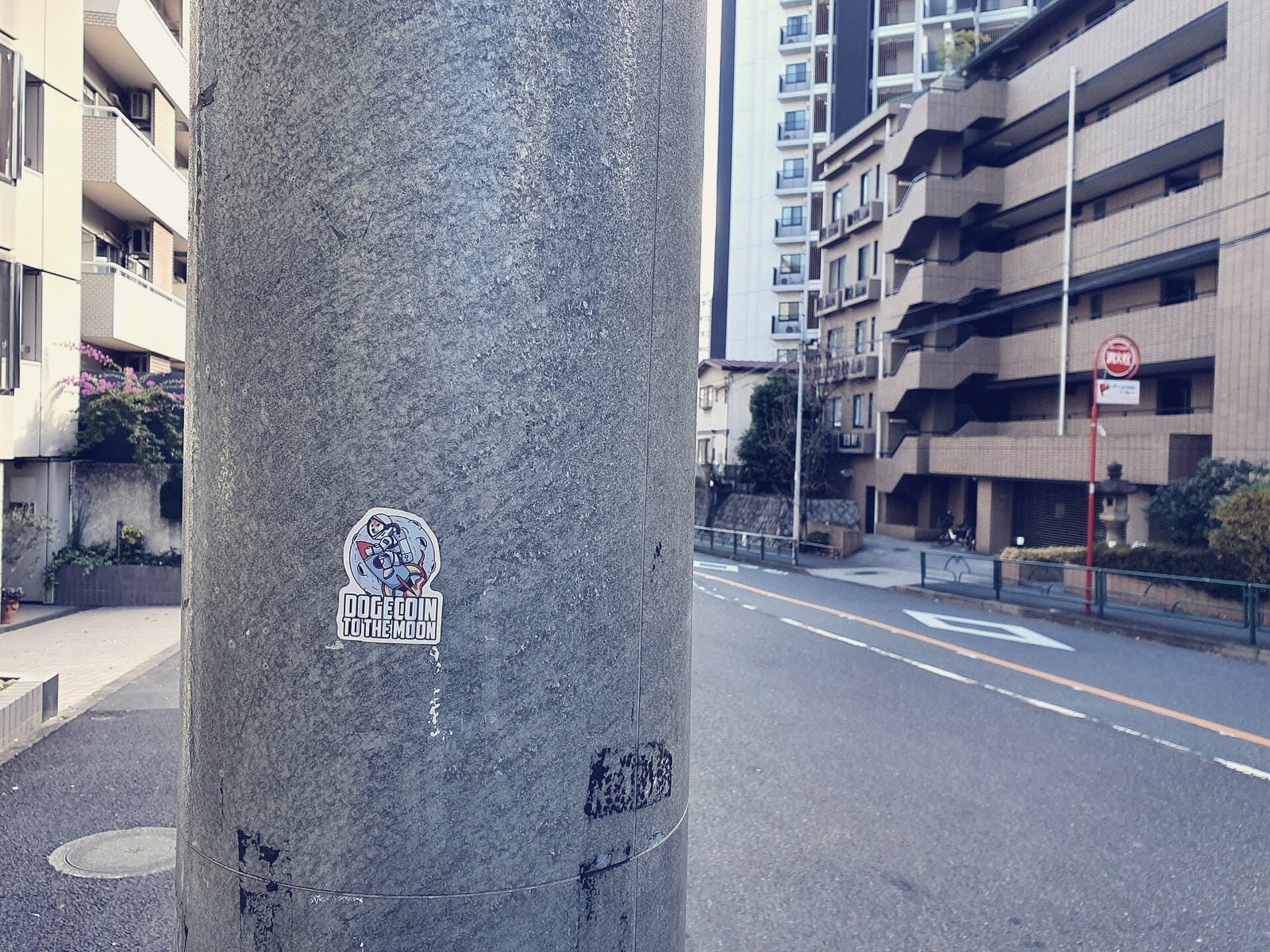
A Dogecoin sticker on a pole in Tokyo is a hopeful object: a rocket and a dog, stuck up by someone who wanted a stranger to know the price might go up. The Project Kimchi poster did the same job with better design and a QR code that opened a token.
The sharpest line in this story is not in the lawsuit or the data. It came from an account that replied to Cohen after the poster vanished: “You literally retweeted a rug pull and made hundreds of people lose money.” The sentence is a complaint, but it is also a description of the career path. The memecoin generation did not make the standard path obsolete by finding a better one. It found a place where the path’s one promise, that effort is rewarded in proportion, is simply switched off, and where the only rule is to be early. The leaderboard is public. The odds are public too. In the latest month CoinGecko reports, nearly every wallet finished within $500 of even, and a rising share finished ahead. What is new is that this now counts as good news.
Not financial advice.
Sources
- Kimchi X account hacked? Project Kimchi token crash, Bitcoin.com News, October 23, 2026
- Kimchi token sheds 98% in 30-minute run to $15M, Cryptopolitan, October 24, 2026
- Just 0.4% of Pump.fun Traders Have Made More Than $10,000 on Solana Meme Coins, Decrypt, January 10, 2025
- Pump.fun Traders Are Making a Comeback, CoinGecko Research, May 7, 2026
- The Memecoin Phenomenon: An In-Depth Study of Solana's Blockchain Trends, arXiv (Davide Mancino), December 4, 2025
- Chainalysis expands Solana coverage to include Pump.fun memecoins, The Block, December 12, 2024
- Top Pump.fun trader's profits near $40 million as Solana memecoin volumes shrink, The Block, March 6, 2025
- Gen Z quant rug pull reveals the dark side of memecoins, DL News, November 20, 2024
- Solana, Pump.fun Named in Amended RICO Suit Alleging $5.5B Meme Coin Gambling Scheme, Decrypt, July 24, 2025
- Pump.fun lawsuit: amended class action calls platform a slot machine, Cointelegraph, July 24, 2025
- Solana Labs Dismissed From Pump.fun Case, Coin Alert News, September 1, 2026
- Gen Z Is Taking More Financial Risks Through Meme Stocks and Crypto, YPulse, June 22, 2026
Image: Syced, Wikimedia Commons, CC0.