The Trader Who Became a Celebrity, and Then a Suspect, in Two Days
Kimchi was said to have made $40 million on a presidential memecoin. The blockchain shows about $6 million, and his own token lasted an afternoon.
On the afternoon of October 22, a photograph appeared on the X account of a trader known as Kimchi. Bitcoin.com News describes a Manhattan sidewalk poster reading “project kimchi, same internet, different outcome,” with a Pump.fun logo, app-store badges and a QR code. Scanning the code opened a brand-new token on the Solana blockchain. Pump.fun’s co-founder, Alon Cohen, reposted the picture. Within seconds the token was worth about $10 million, and it peaked near $15 million.
About half an hour later the post was gone, Cohen’s repost was gone, and the QR code pointed nowhere. By the time Bitcoin.com wrote it up, the token had lost more than 98 percent of its value.
A celebrity, by announcement
Kimchi is a pseudonym, and the press has not settled much else about him. Protos says he rarely posts, and that when he does the posts tend to display wealth; his YouTube channel held a single vlog, a Pump.fun promotion filmed on a private jet. What made him famous, according to Bitcoin.com, was a claim of about $40 million in profit from trading the official TRUMP token after its January 2025 launch. Roughly two days before the launch, Pump.fun had signed him as a creative partner and made him the face of a retail push. Cohen called him, in Protos’s quotation, “the first ever example of a trader becoming a celebrity.” Users were encouraged to become “the next Kimchi.”
The conceit is neat. A memecoin platform’s best advertisement is a person who appears to have won on one, and the platform has every reason to make that person larger than the evidence. The evidence did not cooperate.
Forty million, or six
The analytics firm Bubblemaps traced Kimchi’s linked wallets and put his TRUMP profit at roughly $6 million, a seventh as large as the claim. Protos calls the larger figure unverified and notes that Pump.fun repeated it. Six million dollars is not a small result for a trader of any age, but it is a different story from forty.
Bubblemaps was careful about what it could not see. Its trace covers only part of the wallet cluster, so a larger hidden address is possible. Protos quotes the firm as saying that if one existed, “he likely would have revealed it by now.” That is a fair inference rather than a finding. A person who owns a large undisclosed wallet and chooses to stay quiet about it would look, on the chain, exactly like a person who does not own one.
A community note on Pump.fun’s promotional post added a further wrinkle. It pointed out that Kimchi’s linked wallets are associated with sniping tokens, meaning buying a new coin in its first moments, before ordinary buyers can. Sniping is a skill, but it is also a business in which the first buyer is usually selling to the second.
Unresolved
What happened next is not known, and the two outlets that covered it are careful to say so.
Many users suspected a hack. Others thought the post was deliberate. Protos adds a third possibility, that it was simply a badly managed launch. The reporting does not favour one account over another. The trader Fabiano argued, as Protos relays, that Cohen’s quick repost and quick removal would have required minute-by-minute planning, and that Kimchi’s deleting Pump.fun posts makes little sense if the two had a deal. Onchain investigators cited by Bitcoin.com also questioned the hack story, but a questioned story is not a refuted one, and neither source claims proof of intent by anyone.
The two reports even disagree on the arithmetic. Protos has the token falling from about $14 million to roughly $600,000 within minutes and sitting near $183,000 afterward; Bitcoin.com has a later market value of about $284,000 and trading volume of $8.66 million. Both are snapshots of a market that moved by the minute. The angry replies differed too. One trader told Kimchi, “You literally retweeted a rug pull and made hundreds of people lose money,” in Bitcoin.com’s account; another, per Protos, said “Your founder rugged thousands of people.” Neither Kimchi nor Pump.fun had commented at the time of Bitcoin.com’s report. By Protos’s follow-up on October 26, Kimchi had put Pump.fun back in his bio, and neither he nor Cohen had said more.
What he is evidence of
The trend is the manufactured trader. Social media rewards the person who appears to win, the platforms that profit from volume reward the person who can be seen winning, and the verification layer, the blockchain, is public but read by few until something breaks. In this case the check arrived within days, and it cut the headline number by more than eighty percent.
The risks fall unevenly. Kimchi’s earlier namesake coin, Bitcoin.com reports, reached about $40 million in its first hour after the Pump.fun signing, but an anonymous deployer had bought roughly 79 percent of the supply for about $9,300 and routed the creator fees to a wallet labelled Kimchi. Analysts noted that about three quarters of the supply sat at one address, which makes most of the paper value hard to realise. A price is only a price if someone can sell into it. Those who bought the Project Kimchi token at the top held the other side of that arithmetic.
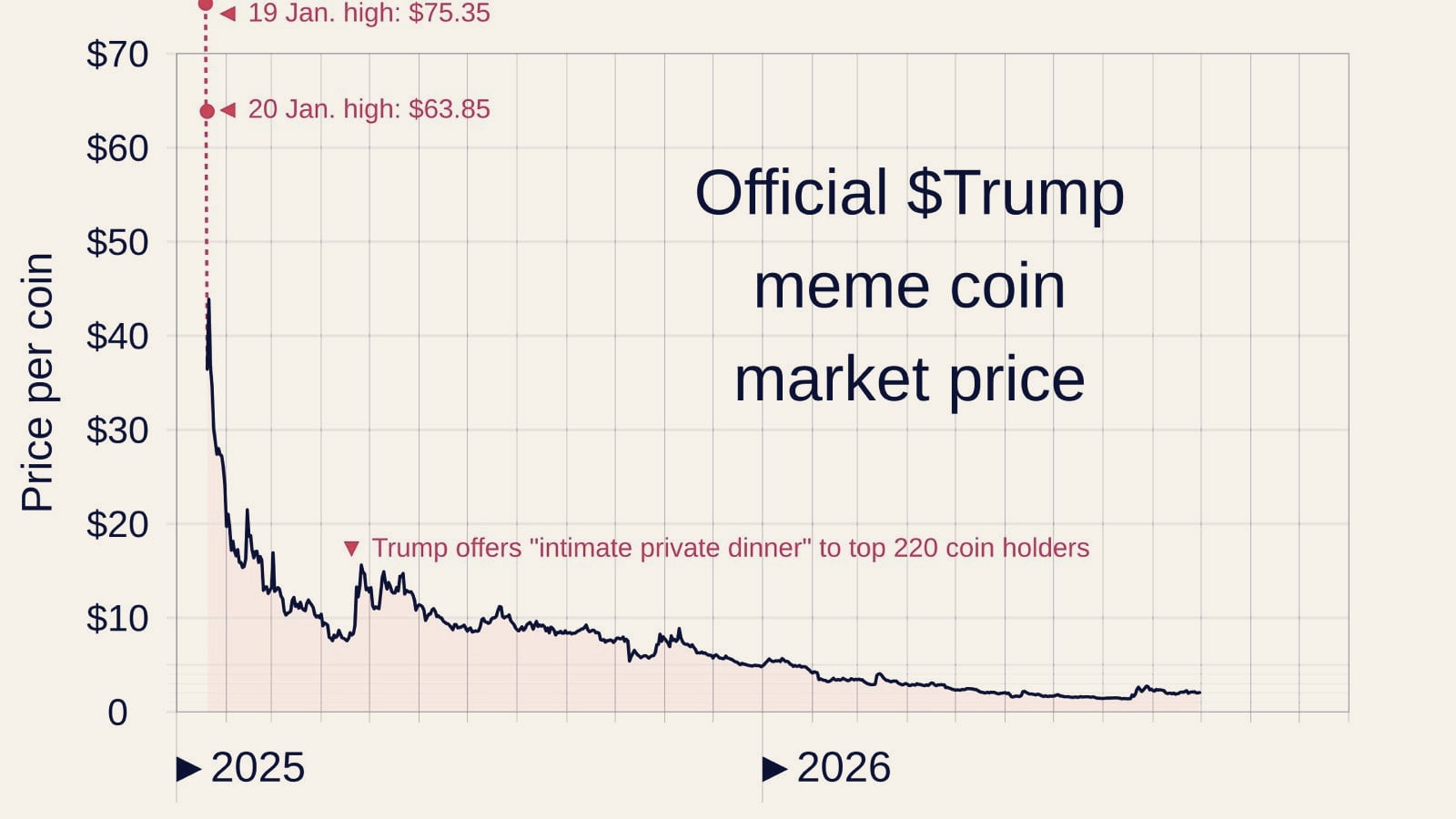
There is luck in the original story, too. A TRUMP trade after that coin’s January 2025 launch was a trade in a moment that may not recur, and a profit made there says little about repeatability. The question that Kimchi’s account has now raised, for himself and for the platform that promoted him, is not how much he made. It is how much of it was ever his to count, and how much was the crowd’s.
Not financial advice.
Sources
- Trader Kimchi Goes From Pump.fun Star to Rug Pull Suspect in 48 Hours, Bitcoin.com News, October 23, 2026
- Pump Fun's Kimchi partnership has turned into chaos, Protos, October 23, 2026
- Pump Fun offers $2.5M prize as traders boycott its missing airdrop, Protos, October 26, 2026
Image: RCraig09, Wikimedia Commons, CC BY-SA 4.0.